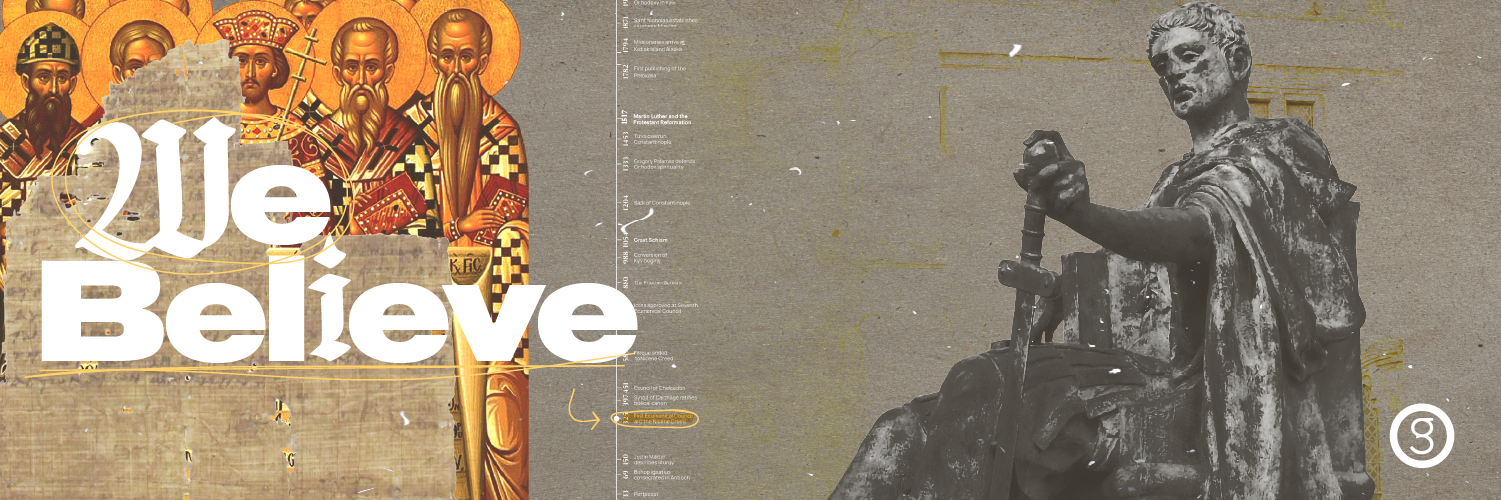
By the early 4th Century, Christianity had spread all over the Roman Empire, deeply impacting Roman culture. Until this point in Christian history those who believed in Jesus faced the very real threat of persecution and even martydom. Yet, in the second decade of the century, the Roman Emperor Constantine embraced Christianity as an official religion of the empire, granting a level of religious freedom for early church for the first time. At the same time, false teachings about Jesus arose, none more critical than a doctrine that became known as Arianism. Named after Arius, a bishop (read “pastor”) from Alexandria, Egypt who espoused the ideas, Arianism taught that Jesus was not fully God, he was a created being begotten by God, and that only the Father was truly God. Arianism taught that Jesus was a type of God, yet also made clear that “There was a time when he (Jesus) was not.” Many in the early church, including a man named Athanasius rebuked this teaching. Constantine feared that the division within Christianity might splinter the faith, and impact his rule. So he called for a council at the city of Nicaea, a Greek City in Bitynia, now northern Turkey to address the differences and bring unity to the church. This first major church council after Acts was attended by over 300 bishops and church leaders at what we now call the Council of Nicaea in AD 325, 1700 years ago. As they gathered and searched the Scriptures, the Council of Nicaea resolutely condemned Arianism as a heresy, and subsequently wrote the Nicene Creed in order to bring clarity to Christian doctrine. This creed has stood the test of time representing the faith Jesus “once for all delivered to the saints,” and is often still recited to this day by churches all over the world as an expression of the common faith held by all Christians.
This Fall, we at Genesis are going to take a quick tour of church history, going back 1700 years so we can understand the theological challenges of that day, and understand how the Council of Nicea defended the truth of the Gospel which is the basis for our Christian unity. And we will journey through the Nicene Creed, which is probably the single most important Christian document outside of the Bible in Christian history. Each week we will recite the Nicene Creed together, joining the voices of millions of Christians all over the world for the past 1700 years. And we will dive into the core beliefs expressed in the Creed, showing their importance for the faith, but also pointing to how each of these doctrines can and should increase our love for and worship of the Triune God.
September 14, Sermon 1 – We Believe (Jude 1:1-5)
The Council of Nicaea was necessary because the heresy of Arianism was spreading through and creating disunity in the church. At this gathering of church leaders, they searched the Scriptures carefully to understand the central truths about the nature of Jesus as truly God and man. The outcome is this 1700 year old creed that defined the essentials for the Christian faith that made sure the church could “defend the faith once for all delivered to the saints.” What we believe really does matter, and there are some beliefs that are essential to be a follower of Jesus. To deny those is to leave the faith. But not all beliefs rise to this level. Therefore it is vital for the church to learn how to do spiritual triage, to figure out which beliefs are heresy, and which beliefs should not divide us. The Nicene Creed set early boundaries for Christian unity both in local churches and all around the world.
September 21, Sermon 2 – One God and Father (Exodus 34:1-9)
John Calvin taught that there are two essential aspects to all true knowledge, knowledge of God and knowledge or self. Yet, those two beliefs are deeply interconnected. To rightly know God is to rightly understand ourselves and the world around us. As God met Moses on the mountain, He revealed His true character and nature. We declare that “We believe in one God the Father almighty,” and in this declaration we confess our belief in the True God, revealed in Scripture, unknowable yet who has revealed Himself to us.
September 28 – Sermon 3 – Maker of Heaven and Earth (Psalm 104)
The reality that God is the maker of heaven and earth declares so much more than the words say. First, this truth is a reminder about the holiness of God, that He is other, separate, apart from creation. There is Creator and there is creation. They are separate, not one in the same. Second, everything that exists owes its existence to God and finds it being and purpose in Him. And third, as the maker of all things, everything in creation including people exist for His glory. Our joy and meaning in life is found when the Gospel opens our eyes to this reality and we live to glorify Jesus and enjoy Him forever.
October 5 – Sermon 4 – One Lord, Jesus Christ (Colossians 1:15-20)
The central dispute at Nicaea involved the nature of Jesus Christ. If there is only one God, how could both the Father and Jesus the Son be truly divine. The Arians did not believe Jesus was God in the same way and with the same substance as the Father. Rather, they believed He was begotten by God, the ultimate created being, but creature none the less. This group declared, “There was a time when he (Jesus) was not.” The church leaders at Nicea boldly rejected this view, affirming the deity of Jesus. God of God, light of light, very God of very God!
October 12 – Sermon 5 – Begotten, Not Made (Philippians 2:5-11)
The central and glorious mystery that defines the Christian faith and separates it from all other paths is the miracle of the incarnation. God stepped into human flesh, became one of us. This means that at one point God indwelt a zygote, was born a human baby, went through adolescence, and lived as a fully human man. He did not lay aside his deity, yet he took on full humanity, “taking the form of a servant.” As a human being He lived a righteous human life, died a human death, and was buried in a tomb. And as a human, he rose again, the down payment for every human resurrection. We cannot truly believe in Jesus without embracing this mystery, that God took on human flesh and dwelt among us.
October 19 – Sermon 6 – One Substance with the Father (John 14:8-31)
Sometimes the smallest things make earth changing differences. At Nicea, the exclusion of a single “I” defined all Christian doctrine. There was much debate about whether Jesus was homoousios or homoiousios with God the Father. Sounds like a fun debate, right? Ousios is Greek for “substance or being.” Homo means “the same”, while Homoi means similar. So was Jesus the exact same substance as God the Father, or merely a similar substance to Him. While the “I” seems insignificant, for Christianity this debate gets to the very heart of theology. The council and creed affirmed that Jesus is the full and same substance as God the Father. The Christian church went on to affirm the full deity of the Holy Spirit. God the Father, Son, and Spirit, one in substance and being, three in person. As Christians, the doctrine of the Trinity is not just a philosophical formula, it is an invitation to know the God who is love. But add the “I” and whatever you have, it is not the Christian faith handed down by Jesus and revealed in the Scriptures.
October 26 – Sermon 7 – Who, For our Salvation (Acts 13:26-41)
Does all of this really matter? We might think that unity is more important than doctrinal clarity. But the bishops at Nicea knew that the very truth of salvation was at stake. Jesus came into the world to save sinners. God sent Jesus to be born to a virgin mother, live as a man, die at the hands of Pilate, be buried in a real tomb, and then rise again for this purpose, to rescue people. Paul proclaimed this salvation in his preaching, reminding people that Jesus did for us what we could not do for ourselves. And there is salvation no where else. To mistake Jesus identity and mission is to miss salvation. Furthermore, to have the right doctrine of Jesus, yet fail to authentically believe is equally damning. Our salvation is the reason Jesus came.
November 2 – Sermon 8 – Whose Kingdom Shall Have No End (Acts 1:6-11)
The Jesus story does not end with the resurrection and then pick up again with His Second coming. The ascension of Jesus is a key event, picturing His coronation and placement in the seat of authority over God’s Kingdom, at His right hand. The disciples were still wondering about an earthly political kingdom. Yet, the Kingdom Jesus inaugurated is something entirely different. The King had come, His Kingdom secured in His death and resurrection, and that Kingdom exploded through the preaching of the Gospel and the planting of churches. At this moment, Jesus is gathering subjects through the church. Yet, there is a day He will return in glory and come as judge. The early Christian church knew of the importance of Christ’s Kingdom. So while we may not know how or when all this will happen, we can know that Jesus rules now and will come again some day, and that His Kingdom will have no end.
November 9 – Sermon 9 – In the Holy Spirit (John 16:1-15)
The Nicene Creed includes a clear and beautiful statement revealing the early church’s understanding of the person and work of the Holy Spirit. He is the Lord, the giver of life, proceeding from both the Father and Son, and to be worshiped along with the Father and Son as God. The Holy Spirit is the voice that inspired the Scriptures, and He is the One who spoke through them to make our hearts alive to believe. The truth is that we can believe the right stuff about the Spirit without really believing in His work in our lives or seeking His presence. Yet, it is the presence of the Holy Spirit in our lives that empowers us to see Jesus clearly and to live boldly for His glory.
November 16 – Sermon 10 – One Holy Catholic Church (Ephesians 2:13-22)
Wait, we believe in the Catholic Church? I thought we were Protestant. The Nicene Creed is joined by almost every creed in church history using this language to confess belief in the doctrine of the church. Well, if we interpret this language to speak of an institution, we do have a problem. But the church was never an institution, it was always the assembly of the redeemed people. The word catholic means “universal”, the affirmation that in Christ God has purchased a people for Himself. Local churches are visible outposts of the universal church. In this light, we do believe in One, Holy, Universal, and Apostolic church made up of those who have believed and been baptized for the forgiveness of sin.
November 23 – Sermon 11 – The Resurrection of the Dead (Romans 8:18-25)
The Christian belief in the final resurrection has always been a doctrine that separates Christianity from most all other world religions. In most belief systems, including the prominent spiritualities in ancient Rome, salvation was obtained when the spiritual part of our existence is freed from the evil of the material world. The Christian story, though, tells a different story in which the whole of God’s creation is restored and those who follow Jesus in life will be resurrected from the dead, their bodies being redeemed. When Paul wrote Romans 8, these words were radical. Sadly, so many still believe in a bodyless heaven. But just as Jesus was raised from the grave, our hope is tied to our final resurrection as well.